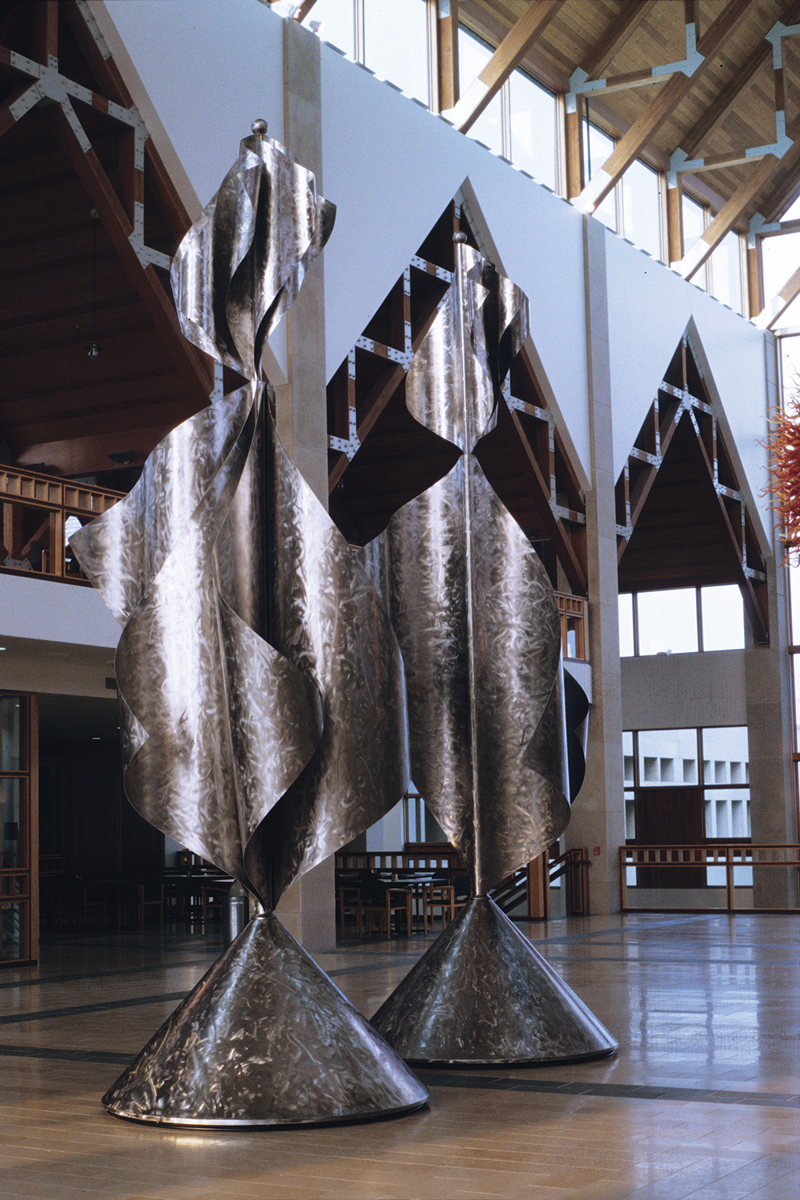
Yin Yang
> Commissioned by Acuity Insurance, Sheboygan, Wisconsin
Located at 2800 S. Taylor Drive, Sheboygan, Wisconsin
Two mirror-image sculptures in stainless steel were created for the corporate headquarters. Each weighs 3,000 pounds. Casters under the base cones allow them to be moved on the floor.
The final form of the Yin Yang sculptures emerged over time, from a variety of individual as well as collaborative efforts.
The initial form emerged several years ago while I was working out some ideas for large-scale works. I often use simple, available materials to create a three-dimensional "sketch".
I began with three rectangular pieces of paper, folded them on the same diagonal, corner to corner, and nestled them together in a book form. The six triangular pages were curled on the edge of the table and spread around the center spine or axis. Next I made a more substantial model from small pieces of flashing tin, running a steel wire along the axis and supporting the configuration vertically. A small cone served as a base and the entire thing was photographed against the sky from a low camera angle to give it the appearance of a large-scale sculpture.
The model went on the shelf and the photo was filed away.
Some years later I got a call from art consultant Catherine Davidson requesting any ideas I had for large-scale sculpture, and this photo was sent along for review. Her presentation to Acuity Insurance resulted in the creation of several models, numerous redesigns, consultations with dozens of fabricators, several structural engineers and final structures of nearly a ton and a half each.
Perhaps the most notable change from the original models was the addition of the smaller-scale configuration of vanes that sits atop each sculpture. It is the result of my meeting at Acuity with Catherine Davidson, Ben Salzmann and Sheri Murphy.
I explained the difficulty of finding a fabricator with 10-foot rollers to form the large vanes. Ben and Catherine wanted more height, so they decided a half-scale version of the main section placed on top would be a good solution.
After recovering from my initial skepticism, I added the top form to the models and it seemed to work quite well. It creates another visual and conceptual dynamic. The title was Ben's choice and seems appropriate. It is non-specific enough to allow for open-ended yet personal interpretations.
The basic images of Yin Yang have their roots in several concepts that have recurred in my work over the years. I enjoy the simplicity of using flat, geometric forms to create volume. Simple geometry orders and transforms space.
Another theme is the chaos of nature balanced and controlled, juxtaposed with the moment of calm.
There is also the power of the vertical. A term used in the realm of comparative religious study is axis mundi or the center of the world.
The earlier analogy of a book may be lost in the final translation, but the flowing and sequential vanes suggest progression and transformation.
The somewhat aggressive and random surface treatment is intended to reflect light and enhance the contrast of form and line. Like water, there is dual character of flatness and depth.
Yin Yang, 2006
stainless steel
18'9" H x 8' W x 9' D
3,000 lbs. each
Located at 2800 S. Taylor Drive, Sheboygan, Wisconsin
Two mirror-image sculptures in stainless steel were created for the corporate headquarters. Each weighs 3,000 pounds. Casters under the base cones allow them to be moved on the floor.
The final form of the Yin Yang sculptures emerged over time, from a variety of individual as well as collaborative efforts.
The initial form emerged several years ago while I was working out some ideas for large-scale works. I often use simple, available materials to create a three-dimensional "sketch".
I began with three rectangular pieces of paper, folded them on the same diagonal, corner to corner, and nestled them together in a book form. The six triangular pages were curled on the edge of the table and spread around the center spine or axis. Next I made a more substantial model from small pieces of flashing tin, running a steel wire along the axis and supporting the configuration vertically. A small cone served as a base and the entire thing was photographed against the sky from a low camera angle to give it the appearance of a large-scale sculpture.
The model went on the shelf and the photo was filed away.
Some years later I got a call from art consultant Catherine Davidson requesting any ideas I had for large-scale sculpture, and this photo was sent along for review. Her presentation to Acuity Insurance resulted in the creation of several models, numerous redesigns, consultations with dozens of fabricators, several structural engineers and final structures of nearly a ton and a half each.
Perhaps the most notable change from the original models was the addition of the smaller-scale configuration of vanes that sits atop each sculpture. It is the result of my meeting at Acuity with Catherine Davidson, Ben Salzmann and Sheri Murphy.
I explained the difficulty of finding a fabricator with 10-foot rollers to form the large vanes. Ben and Catherine wanted more height, so they decided a half-scale version of the main section placed on top would be a good solution.
After recovering from my initial skepticism, I added the top form to the models and it seemed to work quite well. It creates another visual and conceptual dynamic. The title was Ben's choice and seems appropriate. It is non-specific enough to allow for open-ended yet personal interpretations.
The basic images of Yin Yang have their roots in several concepts that have recurred in my work over the years. I enjoy the simplicity of using flat, geometric forms to create volume. Simple geometry orders and transforms space.
Another theme is the chaos of nature balanced and controlled, juxtaposed with the moment of calm.
There is also the power of the vertical. A term used in the realm of comparative religious study is axis mundi or the center of the world.
The earlier analogy of a book may be lost in the final translation, but the flowing and sequential vanes suggest progression and transformation.
The somewhat aggressive and random surface treatment is intended to reflect light and enhance the contrast of form and line. Like water, there is dual character of flatness and depth.
Yin Yang, 2006
stainless steel
18'9" H x 8' W x 9' D
3,000 lbs. each